


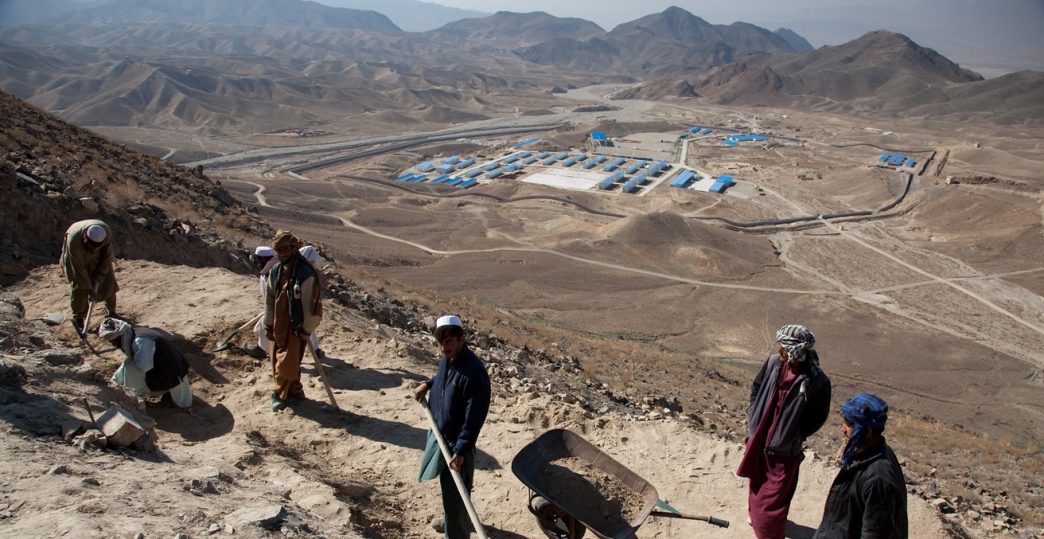
The Taliban government is turning to Afghanistan’s vast mineral wealth to revive the country’s struggling economy, after losing billions in international aid following the group’s return to power in 2021.
With Afghanistan facing severe economic isolation, the Taliban is pushing to capitalize on the country’s estimated $1 trillion in untapped mineral reserves, which include lithium, copper, iron ore, rare earth elements, and gold.
China, Russia, and Iran are emerging as key partners in the Taliban’s mining push, as these countries look to secure critical resources and strengthen their influence in the region. 
Beijing, in particular, is leading the charge. Chinese companies have ramped up talks with Taliban officials to secure mining rights for Afghanistan’s lithium reserves, a resource that is crucial for electric vehicle batteries and other technologies driving the global energy transition.
Lithium, often referred to as “white gold,” is one of Afghanistan’s most valuable resources. Analysts believe Afghanistan could become a major player in the global lithium market if its reserves are properly developed, rivaling other top producers like Australia, Chile, and China.
China’s interest in Afghanistan’s minerals is strategic. The country already dominates the global supply chain for critical minerals, and securing Afghanistan’s resources would further strengthen its grip on the sector.
In January 2023, China’s Xinjiang Central Asia Petroleum and Gas Co. signed a 25-year contract with the Taliban to extract oil from the Amu Darya basin in northern Afghanistan. The deal marked the first major energy investment under the Taliban’s rule and signaled China’s willingness to do business with the regime.
Russia and Iran have also stepped up their engagement with Kabul. Both countries, facing Western sanctions, are seeking closer economic ties with Afghanistan and access to its natural resources.
In September 2023, Russian officials met with Taliban representatives in Kazan to discuss potential mining projects, particularly in the copper and iron ore sectors. Iran has similarly expressed interest in joint ventures to develop Afghanistan’s mineral deposits.
While the Taliban is eager to attract foreign investment, the country’s mining sector faces significant challenges. Security concerns, lack of infrastructure, and political instability continue to deter many Western companies from entering Afghanistan’s resource-rich areas.
Illegal mining remains rampant across Afghanistan, with local warlords, criminal networks, and Taliban factions profiting from unregulated extraction. The United Nations has warned that proceeds from illegal mining are being used to fund militant activities, creating further risks for the country’s stability.
Afghanistan’s mineral wealth has long been viewed as a potential solution to its economic woes.
The U.S. Geological Survey has identified vast deposits of copper, iron, gold, and rare earth elements, along with an estimated 1.4 million metric tons of lithium.
During the U.S. military presence in Afghanistan, American officials and companies showed interest in developing the country’s resources. However, progress stalled due to the country’s security issues and lack of infrastructure.
Since the Taliban takeover, Western governments and companies have largely withdrawn from Afghanistan, leaving China, Russia, and Iran to fill the void.
China’s Belt and Road Initiative has paved the way for closer ties with Afghanistan. Chinese companies see an opportunity to develop Afghanistan’s mining sector while securing valuable resources for China’s growing economy.
The Taliban government has repeatedly stated that mining is a top priority for Afghanistan’s economic future. In a recent speech, Taliban Deputy Prime Minister Abdul Ghani Baradar said that the regime is committed to making Afghanistan’s natural resources “a pillar of the country’s self-sufficiency.”
Baradar also emphasized that the Taliban welcomes investment from “friendly countries,” a term often used to describe China, Russia, Iran, and other regional partners.
However, Afghanistan’s reliance on mining as an economic lifeline carries risks.
Analysts warn that resource-rich countries often fall victim to the “resource curse,” where an overreliance on minerals can lead to corruption, economic inequality, and political instability.
The Taliban’s ability to manage foreign investment and maintain control over its mineral sector will be critical to determining whether Afghanistan’s natural wealth translates into sustainable economic growth.
For now, China, Russia, and Iran are positioning themselves to gain a foothold in Afghanistan’s mining sector, betting that the potential rewards outweigh the risks of doing business with the Taliban.
If successful, these countries could gain long-term access to some of the world’s most sought-after resources, reshaping the region’s geopolitical landscape and further isolating Afghanistan from Western powers.


